
Blog
Rethinking Subsidy: lessons from social investment on good growth
Policy and Advocacy Manager, Alex Bunker, looks at the lessons from social investment in using subsidy as a tool for delivering good growth
Director of Impact and Evaluation, Lydia Levy, examines the latest set of Enterprise Level Data from BSC to understand how organisations supported through Access funded programmes compare to the wider social investment market.
Building on last year's analysis
For the last few years we have examined Better Society Capital's Enterprise Level Data to understand how organisations supported through Access funded programmes compare to the wider social investment market. With the 2024 data now published, this is our annual update, revisiting those findings to track what has changed and what continues to hold.
Our mission at Access is to expand access to social investment for charities and social enterprises that are often excluded from traditional finance. Central to this is blended finance: combining grant funding with repayable finance to make deals viable for organisations that might otherwise struggle to access investment. The Enterprise Level Data, which brings together information from social investors and intermediaries across the UK, helps us assess whether that approach is working.
As in previous years, we've updated our interactive dashboard so you can explore trends over time, compare Access and non-Access investments, and see where investment is reaching more deprived communities. We recommend opening it in a new tab.
Small but mighty: a pattern that holds
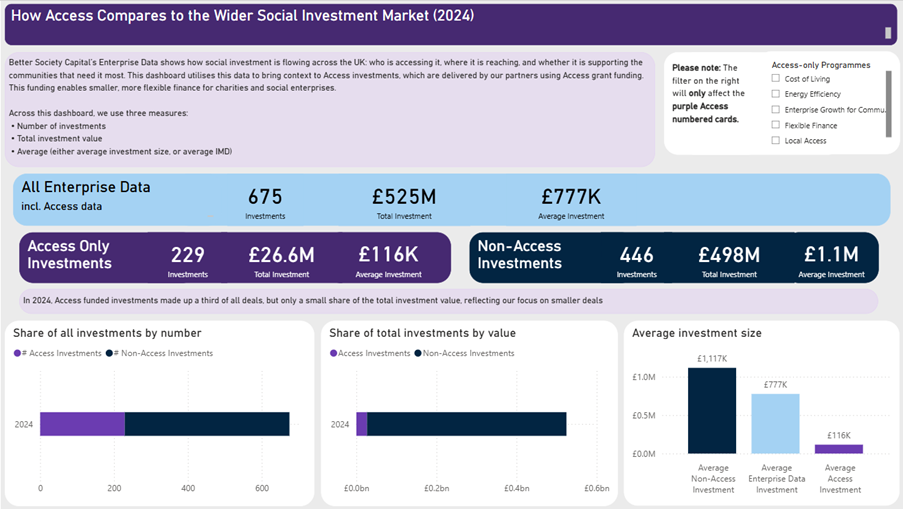
The 2024 data continues a well-established trend: Access programmes support a higher volume of smaller deals than the wider market.
Access funded investments accounted for 229 deals in 2024 - around a third of all deals recorded that year - but just £26.6m of the £525m invested across the market. That gap reflects a deliberate focus on smaller deal sizes. The average Access investment was £116k, against £1.1m for non-Access investments and £777k across the market as a whole. This matters: research (SEUK 2023) suggests the average social enterprise is typically seeking around £80k, so Access and our partners are meeting this need for smaller deals.
Zooming out, the longer-term picture reinforces this. Since Access programmes began, they account for 1,186 investments with an average size of £99k, compared to £644k for non-Access investments over the same period - a sustained contribution to a persistent gap in the market.
Reaching communities in need
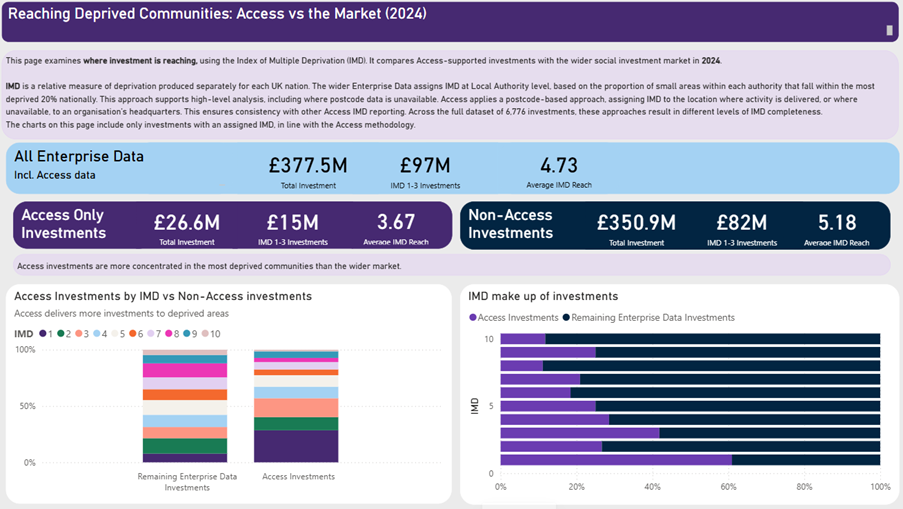
Access funded investments also continue to be more concentrated in deprived areas than the wider market, and the 2024 data is consistent with previous years where postcode data is available.
Using the Index of Multiple Deprivation (IMD), Access investments had an average IMD reach of 3.67, compared to 5.18 for non-Access investments. Lower scores indicate higher deprivation, so the gap here is meaningful. In value terms, £15m of Access investment went to organisations in the most deprived IMD bands (1–3), out of £26.6m total - a significantly higher proportion than the £82m reaching those same bands from the £350.9m of non-Access investment.
Blended finance is a key part of why these deals happen at all. Grant funding alongside repayable finance helps unlock opportunities that wouldn't be viable on purely commercial terms.
What the data tells us
The 2024 Enterprise Level Data reinforces what previous years have shown. Access programmes - working through our partners - continue to reach smaller organisations and those in more deprived communities: the organisations that find it hardest to access social investment through mainstream routes.
As the dataset grows year on year, so does our ability to track these patterns with confidence. We'll keep using it to sharpen our understanding of where blended finance is making a difference, and where gaps remain.
Methodology notes