
Blog
Rethinking Subsidy: lessons from social investment on good growth
Policy and Advocacy Manager, Alex Bunker, looks at the lessons from social investment in using subsidy as a tool for delivering good growth
What we’re learning about financing energy retrofit for charities and social enterprises as a result of our Energy Efficiency Social Investment Programme (EESIP).

Early insights from EESIP
Improving the energy performance of buildings remains an important consideration for charities and social enterprises. Many organisations continue to face challenges linked to older buildings, rising operating costs, and the need to maintain comfortable, resilient spaces for the people they support. The Energy Efficiency Social Investment Programme (EESIP), backed by Dormant Assets Scheme, provides a helpful view of how retrofit can be delivered in practice. Now that most of the funds are complete or well underway, we have a clearer understanding of what worked well, where difficulties emerged, and what this means for future approaches to energy-related investment.
Programme snapshot
The programme portfolio offers an early picture of how retrofit demand is translating into real projects. The scale of activity and the balance between repayable finance and grant support highlight both appetite and constraint: organisations are keen to invest in their buildings, but viability remains closely tied to blended funding.
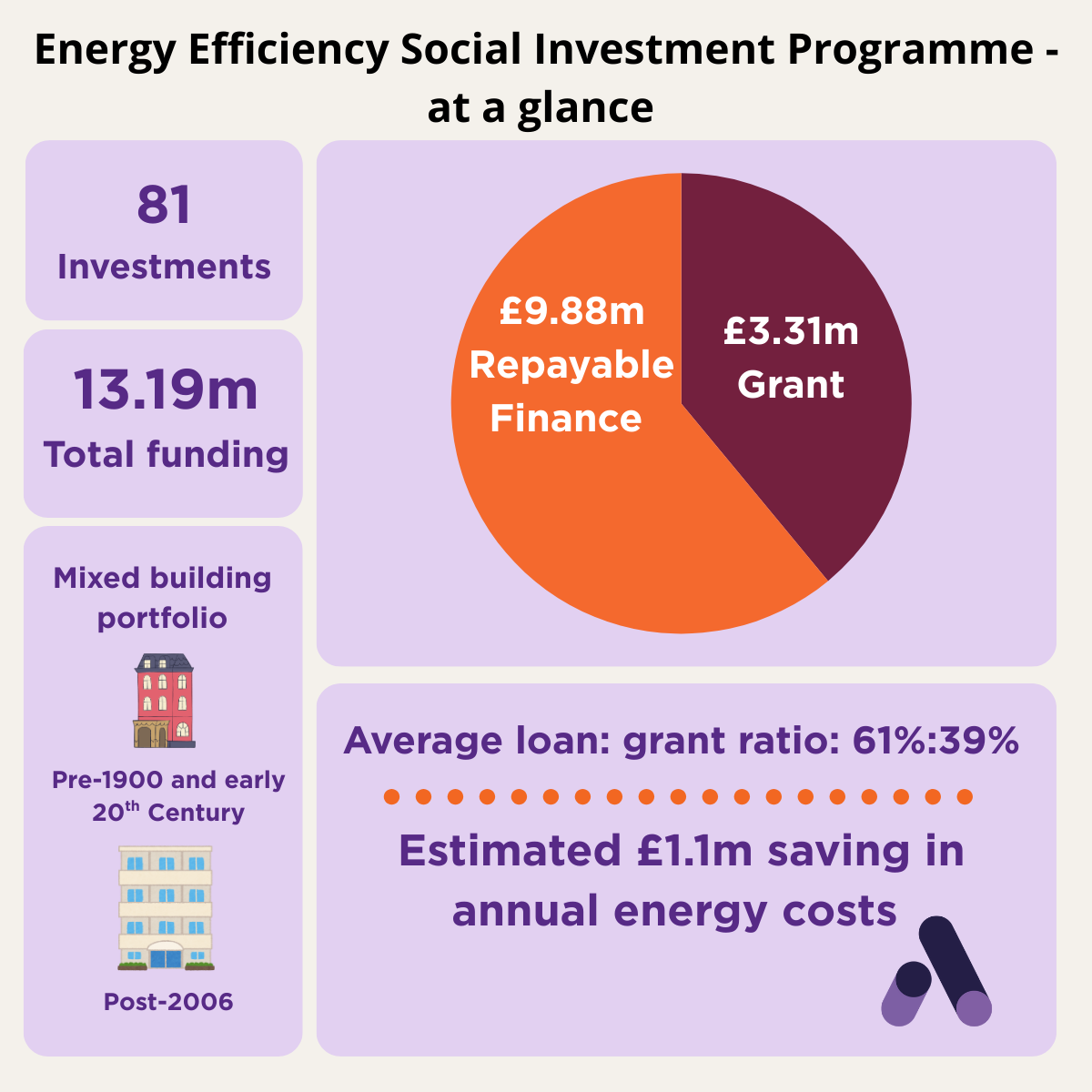
Seen in context, the overall funding pattern reinforces a consistent delivery insight. Energy upgrades often generate strong long-term savings, but the upfront economics can still be difficult for charities to absorb. Grant support has therefore been central to unlocking projects, allowing organisations to move ahead where repayable finance alone would not have been sufficient.
The portfolio also illustrates how retrofit demand spans a wide range of building types. Many projects involve older stock where inefficiency is more pronounced, and improvement works can be technically complex. At the same time, newer buildings are also appearing in the pipeline, reflecting how rising energy costs are prompting organisations to revisit recent developments and add measures that were not originally included.
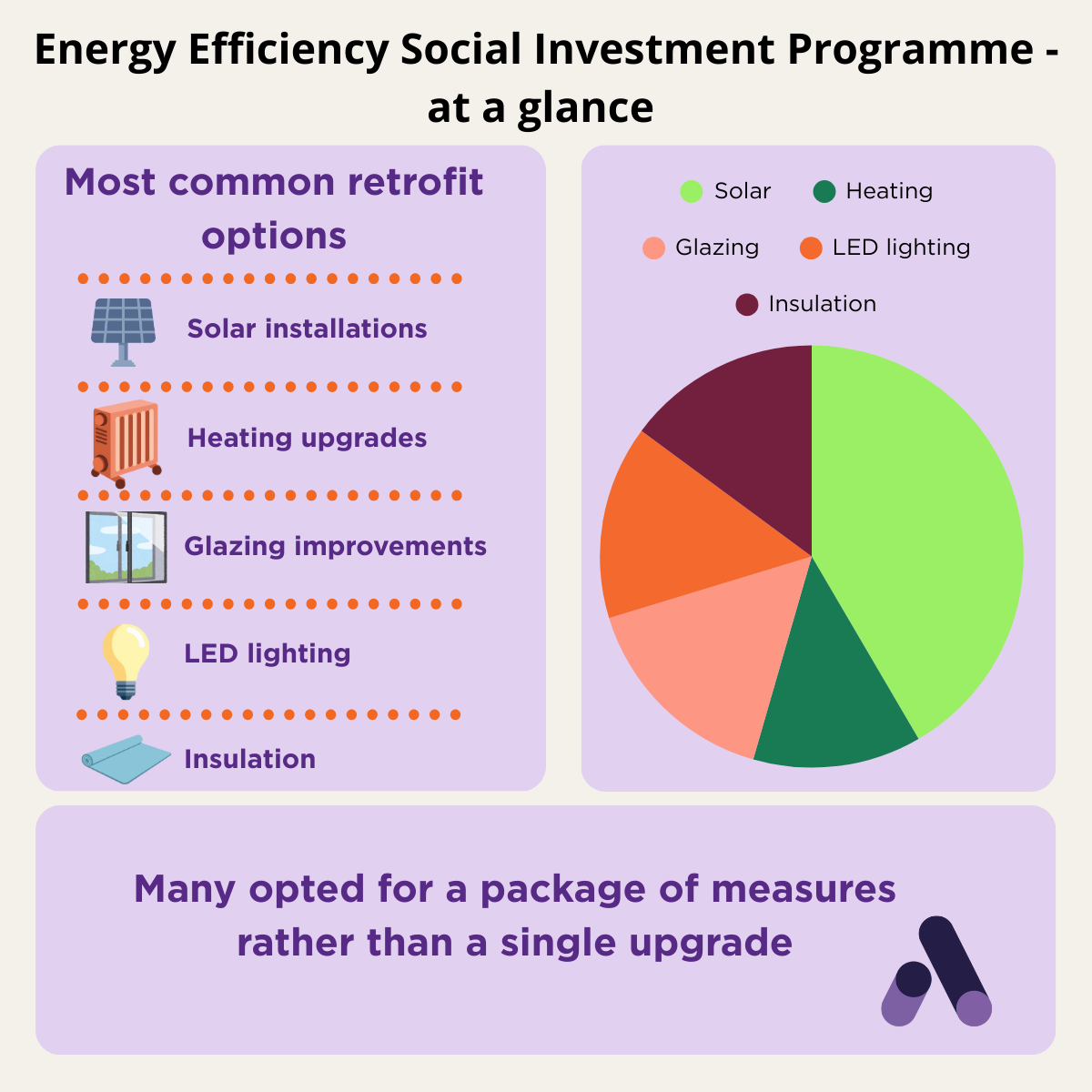
Taken together, the building mix and intervention patterns show that retrofit is rarely treated as a single upgrade decision. Organisations are often combining measures to maximise impact, both to reduce energy costs and to make better use of their space for delivery and community benefit. This reflects a practical approach where energy improvements are considered alongside how buildings support an organisation’s wider mission.
A consistent challenge was engaging diverse-led organisations, many of whom are less likely to own buildings or hold long-term leases. Work is underway to explore how grant support and partnerships could improve take-up, though it will not remove all constraints.

The following sections: “Successes and why the model worked”, and “What could be improved” were written by Charity Bank based on their delivery experience.
Successes and why the model worked
A consistent finding across delivery was how critical the grant funding model was to enabling projects. The fully grant-funded building assessments gave organisations a clear view of their options from the outset, while the accompanying capital grant made most projects financially viable. Without this combination, many investments would not have progressed. A high number of assessments were completed overall, including for organisations that chose not to proceed, meaning many still benefited from a better understanding of their buildings and potential energy measures.
The assessments themselves were consistently strong and played a central role in moving projects forward. They helped organisations understand what was achievable on their sites and often shifted them from initial interest to a clear delivery plan. Typical payback periods of five to eight years provided additional confidence, and many organisations chose to align energy efficiency measures with wider refurbishment or development works.
The simplicity of the programme also supported delivery. The offer was intentionally easy to navigate, and working with existing customers reduced the administrative burden as key information was already held. Assessment grants were often approved very quickly, sometimes within around 40 minutes, which helped maintain momentum and keep organisations engaged. Allowing organisations to appoint their own installers avoided supply chain delays, and national assessor coverage, while requiring coordination, helped prevent bottlenecks.
Engagement from relationship managers added further value. Drop-in clinics supported understanding and trust in the process, while regular conversations helped organisations make informed decisions.
What could be improved?
Charity Bank identified several ways a future round of the programme could be strengthened. A clearer breakdown of the grant and loan offer from the outset would support earlier, more informed conversations with customers, and mobilising relationship managers sooner would help build momentum earlier in the cycle.
A longer delivery window would also better reflect the time required for assessments, decision-making and capital works, particularly where energy measures form part of broader refurbishment or development plans.
Flexibility in the grant share was valued by organisations, and there may be scope to make this more explicit, especially for groups working in low-income communities or delivering more complex projects. Charity Bank also highlighted the importance of building a stronger pipeline, particularly among organisations that are less likely to approach the fund independently.
Case study: Kent Wildlife Trust – Sevenoaks Wildlife Reserve
Charity Bank supported the refurbishment of the Sevenoaks Wildlife Reserve visitor centre with a £62,000 grant alongside wider investment. This funding enabled the installation of solar panels and electric vehicle charging points as part of the redevelopment, helping the charity cut future energy costs and reduce its environmental impact.
The upgraded facilities will allow Kent Wildlife Trust to welcome more visitors, host events and generate additional income, while ensuring the centre operates more sustainably. The improvements will support both long-term financial resilience and better access to nature for local communities.
Looking ahead
The next set of dashboards and further analysis will be published soon, drawing on the monitoring data now being collected. This will help build a clearer picture of the savings achieved and the wider benefits for organisations and the people using their spaces. The next phase will explore how these insights can shape the design of future funds that better support the sector to deliver energy improvements.